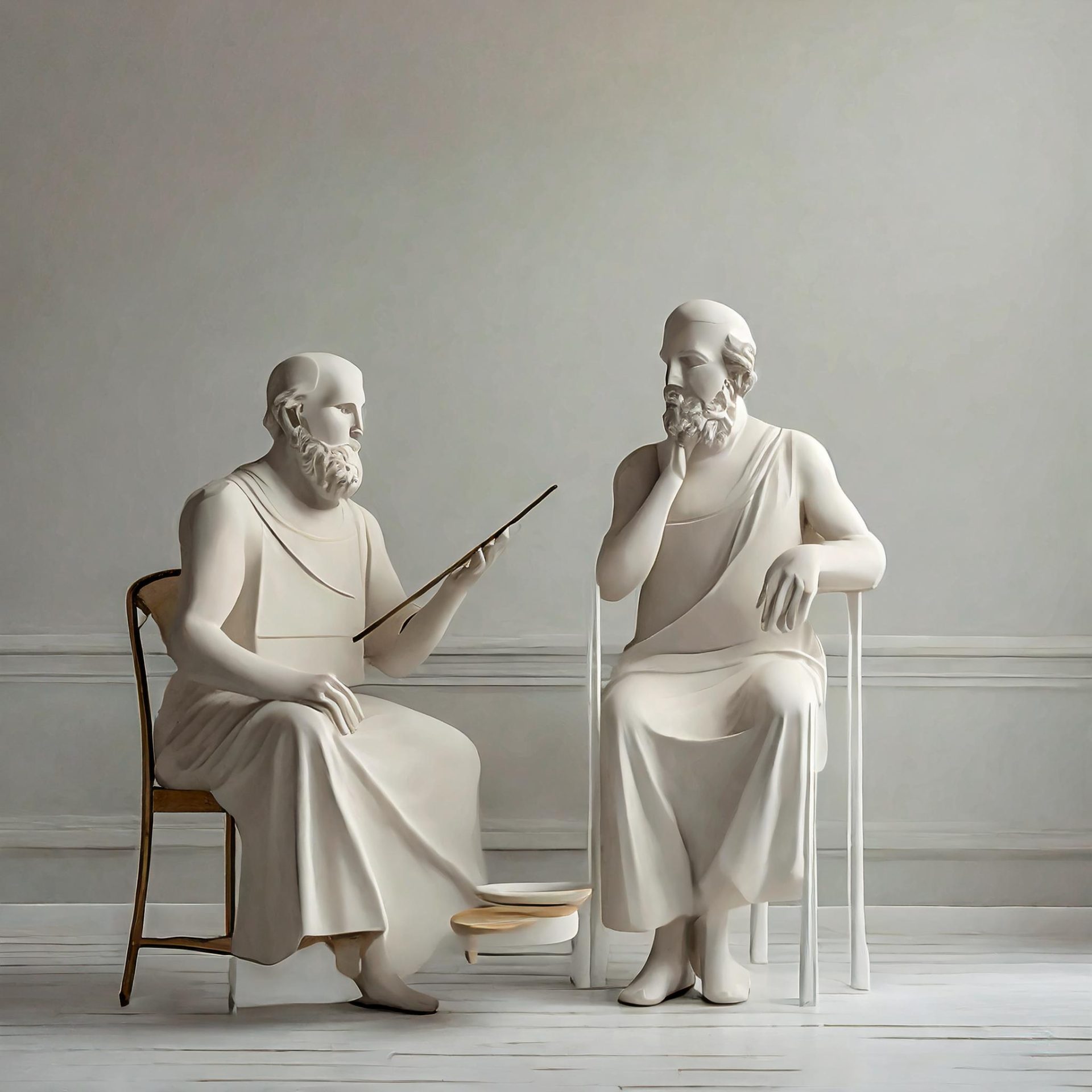
An overview of the concept of God through the lens of Aristotelian and Platonic ideas of causation and motion
It has been argued that Aristotle’s notion of God as the prime mover is the crown of his metaphysics and consequently his entire theoretical philosophy.[1] It is said that this development of thought has been transcendental in the history of natural theology because it places God as the philosophical first principle of everything for the first time in history.[2] This notion of the prime mover or God appears most clearly, though not exclusively, in his work the Metaphysics. In contrast, his predecessor and teacher Plato depicts a more abstract, fluid and even mythical notion of God throughout his own body of work, namely through his Theory of Ideas.[3] Yet, it is impossible to discuss Aristotle’s notion of God without discussing the embedded Platonism that pervades his own thinking and corpus. As Stephen Menn states, «there is something Platonic about Aristotle’s God».[4] Werner Jaeger posits Aristotle’s doctrine on God as a modification of Plato’s theism as mentioned in The Republic and Timaeus.[5] It is the aim of this essay to explore Aristotle’s notion of the prime mover by contrasting it to Plato’s notion of God through the analysis of two key texts. Both texts propose arguments for the creation and movement of celestial bodies thereby highlighting some key differences as well as points of convergence.
Plato’s God
According to H. De Lacy, Plato’s treatment of causation is completely antithetical to physical causation as he considers it transcendental.[6] Plato does not associate causation with the motion and change of particulars, but with the metaphysical participation of these with Ideas.[7] It follows thus that his God would act and enact movement within this metaphysical framework, as can be seen in the following text:
In any case, time was created along with the universe, and since they were created together, they will also perish together, if they do ever perish. And the creation of the universe conformed to the model of eternity, so as to be as similar to it as possible. For the model exists for all eternity, while the universe was and is and always will be for all time. This was how the god reasoned and planned for the creation of time. As a result, in order that time might be created, the sun and the moon and five other heavenly bodies — the so-called planets — were created to determine and preserve the numbers of time. Once he had made bodies for each of them, he put them into the orbits within the circuit of difference, seven bodies for seven orbits. He put the moon into the first circle around the earth, he put the sun into the circle second closest to the earth, and the Morning Star and the planet which is said to be sacred to Hermes he put into circles with the same speed as the sun, but assigned them tendencies that oppose it. Consequently, the sun, Hermes’ planet, and the Morning Star constantly overtake and are overtaken by one another. As for the other three planets, a thorough account of where and why he located them as he did would make this supposedly subordinate discussion longer and more troublesome than the main discussion it’s meant to be serving. There might perhaps be time for a proper explanation of these matters later.
Plato, Timaeus, 38b6–c6 [8]
The first point of note in the text is the division of reality into the sensible (perishable) and suprasensible (eternal). God creates time and the universe in the sensible realm but conforming to an eternal model that exists for all eternity in a suprasensible reality. Another point of interest which contrasts sharply with that of Aristotle is the lack of a clearly defined telos in that which is created, «they will also perish together if they do ever perish». A further reflection note is the level of movement that this creator God actively carries out. He is highly engaged with the world he is shaping into being in stark contrast with the unmoved mover of Aristotle. Overall, one could pose the argument that Plato’s sense of causation lies implicit in the soul of things which respond to a higher order of being.[9] According to H. De Lacy, this is as close as we get to an efficient cause in Plato, while stating that Aristotle himself «found no adequate provision for efficient causation in relation of Ideas to particulars».[10] Where Plato sees soul as the main driving force that connects with the realm of Ideas, Aristotle will see substance.
Aristotle’s God
If Plato’s causation can be found in the participation of particulars with Ideas where the latter are the ultimate source of knowledge and truth, Aristotle’s causation is found in particulars themselves via their substance, which ultimately define their finality. In the following text, we see a starkly different notion of God.
And since the moving cause in the case of natural things is for a human a human, and in those that come from thought it is the form or its contrary, there will be in a way three causes, while in a way there are four, For the craft of medicine is in a way of health, and the craft of building is form of a house, and human begets human; and, furthermore, beyond these there is what as the first of all [movers] moves all things.
Aristotle, Metaphysics, 1071a 29-35[11]
According to Hugh Tredennick, it is in this section that Aristotle first distinguishes the ultimate efficient cause from the proximate cause.[12] It is also here that he mentions the prime mover within Book XII for the first time. It is not surprising to find this introduction here, in the context of his Four Causes. I concur with Stephen Menn in that Aristotle «needs to arrive here» in part because of the implications of his Four Causes. H. De Lacy also adds that Aristotle was trying to locate and systemise what Plato had not been able to do with his causation in his Theory of Ideas.
For substances are primary among beings, and if they are all capable of passing away, everything is capable of passing away. But it is impossible that movement either came into being or passed away. But it is impossible that movement either came into being or passed away (for at every point it was), or that time did, since there cannot be a before and an after if there is no time. Movement too is continuous, then, in the way that time also is, since time is either the same thing as movement or an attribute of it. But there is no continuous movement except in place, and of this only that which is circular is continuous
Aristotle, Metaphysics, 1071b, 4-11[13]
Here it is important to mention the importance Aristotle gave to movement, and how this also shapes his eventual notion of God. First, Aristotle holds that all movement requires a mover but sees that this could lead to infinite regression which he rules out.[14]
The starting-point and primary being is immovable both intrinsically and coincidentally, but it causes the primary eternal and single movement. But since what is moved must be moved by something, and the prime mover must be intrinsically immovable, and eternal movement must be caused by something eternal, and single movement by a single thing, and since we see that beyond the simple spatial substance movement of the universe, which we say the primary and immovable substance causes, there are other spatial movements—those of the planets—that are eternal (for the body with a circular movement is eternal and unresting, as has been shown in our works on natural science), each of these spatial movements must be caused by a substance that is both immovable and eternal. For the nature of the stars is eternal, because it is a certain substance and the mover is eternal and prior to the moved, and what is prior to a substance must be a substance. It is evident, accordingly, that there must be this number of substances that are in their nature eternal and intrinsically immovable, and without magnitude due to the cause mentioned earlier.
Aristotle, Metaphysics XII, 1073a 23-38
Unlike Plato’s God, Aristotle’s is immovable and causes a single, primary and eternal movement that causes all other movements, beginning with the celestial bodies. There is no frenetic activity of creating or shaping the world on his part. He is detached from that which he set in motion. Aristotle’s cosmology here is also very similar to that of Plato’s, who places the orbital motion of the planets as eternals. He makes the observation that these are also perfect due to their circular perfect motion. The other major departure from Plato’s cosmology is that there are no longer two worlds, but one.
Discussion
Plato and Aristotle diverged significantly in their respective notions of God. These views are often seen on opposite ends, but I concur with Menn who argues that there is enough scholarly evidence to suggest that despite Aristotle’s work arising from the need to account for Plato’s lack of a well-defined systemisation of his philosophy, his Platonism always remained somewhat.[15] The texts explored above highlight a couple of stark differences between the two authors’ notions of God. First, how God fits, or even defines their views on causation. Plato’s soul and Ideas source of causation versus Aristotle’s Four Causes. Second, the teleological and ontological landscape that arises as result of their views. Last, we see a vast difference in the way those views are written down which also indicate their individual approaches. Plato with his more abstract top-down approach and Aristotle’s pragmatic method from the ground up that defines natural theology for centuries afterwards.
Bibliography
Primary
Aristotle, Metaphysics, trans. C.D.C Reeves, Hackett Publishing Inc, 2016
Plato, Timaeus. Critias. Cleitophon. Menexenus. Epistles.trans. R. G. Bury, Loeb Classical Library 234, Harvard University Press, Cambridge, MA., 1929
Secondary
Eudaldo Forment, El Problema de Dios en la Metafísica, Promociones Publicaciones Universitarias, Barcelona, 1986
Hugh Tredennick in http://www.perseus.tufts.edu/hopper/text?doc=Perseus%3Atext%3A1999.01.0052%3Abook%3D12
Accessed on 19/11/2021
Jonathan Barnes (Ed.), The Cambridge Companion to Aristotle, Cambridge University Press, 1995, ch.3
Phillip H. De Lacy, The Problem of Causation in Plato’s Philosophy, Classical Philology, Vol. 34, No. 2, 1939
Stephen Menn, Aristotle and Plato on God as Nous and as the Good. The Review of Metaphysics, Vol. 45, No. 3, 1992
Stephen Menn, Plato on God as Nous, Journal of the History of Philosophy Monograph Series, Southern Illinois University Press, 1995
Werner Jaeger, Aristotle: Fundamentals of the History of his Development, trans. Richard Robinson, Claremont Press, 1948, Oxford: chs. 6 & 8
Footnotes
[1] Stephen Menn, Aristotle and Plato on God as Nous and as the Good. The Review of Metaphysics, Vol. 45, No.3, 1992, pp.543
[2] Eudaldo Forment, El Problema de Dios en la Metafísica, Promociones Publicaciones Universitarias, Barcelona, 1986, pp.34-35
[3] Phillip H. De Lacy, The Problem of Causation in Plato’s Philosophy, Classical Philology, Vol. 34, No. 2, 1939, p.99
[4] Stephen Menn, ibid, pp.543-544
[5] Werner Jaeger, Aristotle: Fundamentals of the History of his Development, trans. Richard Robinson, Oxford: Claremont Press, 1948, pp.148
[6] Phillip H. De Lacy, ibid, p.99
[7] Ibid, pp106
[8] Plato, Timaeus, Critias, Cleitophon, Menexenus, Epistles, trans. R. G. Bury, Loeb Classical Library 234, Cambridge, MA., Harvard University Press, 1929
[9]Stephen Menn, Plato on God as Nous, Journal of the History of Philosophy Monograph Series, Southern Illinois University Press, 1995, p.34
[10] Phillip H. De Lacy, ibid, pp.102-103
[11] Aristotle, Metaphysics, trans. C.D.C Reeves, Hackett Publishing Inc, 2016
[12] Hugh Tredennick in http://www.perseus.tufts.edu/hopper/text?doc=Perseus%3Atext%3A1999.01.0052%3Abook%3D12
[13] Ibid.
[14] Jonathan Barnes Metaphysics in Jonathan Barnes (Ed.), The Cambridge Companion to Aristotle, Cambridge University Press, 1995, ch.3, p.104
«If a is in motion, then there is something that is moving a. Hence, on pain of regress, there must be unmoved movers: a is moved by b, b is moved by c, … and, eventually, y is moved by z, which is itself motionless […] Hence if there are any objects in eternal motion, there must be some eternal unmoved mover»
[15] Stephen Menn, Aristotle and Plato on God as Nous and as the Good. The Review of Metaphysics, Vol. 45, No.3, 1992